Rising bond yields are exposing a deeper problem: the era of cheap borrowing may be ending as debt, deficits, inflation, and a wartime oil shock put simultaneous pressure on major economies.
For years, governments around the world borrowed enormous sums without facing much immediate penalty from financial markets. That era is becoming visibly harder to sustain right now, in real time.
Government bond yields have surged across the world’s largest economies this year — the United States, Japan, Germany, France, and the United Kingdom all included — and the moves aren’t subtle. Each country has its own specific fiscal problems, but they’re colliding with a shared external shock: the Iran war and the resulting spike in oil prices have revived inflation fears just as investors were already growing warier of government debt loads built up over years of ultra-low rates. Together, these forces are producing one of the sharpest global bond selloffs in decades.
Investors are demanding real compensation for holding government debt again — and that’s a problem that reaches well beyond the bond market itself.
The Bond Market Is Becoming the Messenger
Bond yields aren’t just numbers watched by traders — they set the cost of borrowing throughout the entire economy. When government bond yields rise, other interest rates tend to follow: mortgages, business loans, and corporate credit can all get more expensive.
That makes government debt levels unusually consequential, because governments can keep issuing more debt to fund spending, but they can’t permanently ignore what it costs to service that debt. The larger the debt stock, the more sensitive the whole budget becomes to even modest interest-rate moves — which is exactly why this year’s bond-market turbulence deserves real attention.
This Is Not Just an American Problem
The United States remains an important case, but it’s genuinely not the epicenter this time. Japan’s benchmark 10-year government bond yield hit 3 percent on September 1, 2026 — its first time at that level since 1996, a full 30-year high — while the 20-year JGB touched 3.885 percent and the 30-year closed at a record 4.18 percent. Japan’s finance minister declined to comment when reporters asked about the milestone directly.
The timing matters: Japan’s own fiscal 2026 budget assumed a 3 percent long-term interest rate when calculating debt-servicing costs, meaning yields breaking above that level immediately adds real strain to a country already carrying debt exceeding 200 percent of GDP.
The UK situation looks similarly stark. The 30-year gilt yield surged to 5.89 percent and the 10-year to 5.25 percent in early September — the 30-year figure the highest since 1998 — squeezing Chancellor’s fiscal headroom from roughly £26 billion down to about £13.8 billion ahead of the government’s late-October budget, according to Deutsche Bank estimates.
The U.S. 10-year Treasury yield touched 4.81 percent in early September, its highest level since 2023, before easing slightly to 4.74 percent after Fed officials signaled some openness to holding rates steady. German and French borrowing costs have climbed to multi-year highs over the same stretch. As CNN’s own market coverage put it plainly: “the rise in yields is a global phenomenon.”
Different countries have different specific vulnerabilities, but one factor connects nearly all of them: governments carrying historically large debt loads, hit simultaneously by a shared inflation shock.
Debt Becomes More Expensive When Rates Stay High
The United States illustrates the underlying mechanics clearly. Federal debt now sits around 122 percent of GDP, compared with roughly 55 percent in 2000 — and the comparison matters because interest rates were actually higher in 2000 than they are even now.
The difference is that the government was carrying far less debt back then. Today, even a moderate rise in borrowing costs has an outsized effect, simply because there’s so much more debt outstanding on which interest has to be paid. U.S. interest payments are projected to exceed $1 trillion this year, according to the Committee for a Responsible Federal Budget — putting interest costs above what the government spends on Medicaid or national defense.
That sets up a genuinely dangerous feedback loop: more debt produces larger interest payments, larger interest payments require more borrowing to cover, more borrowing raises concerns about future debt sustainability, and heightened concern pushes investors to demand still-higher yields to compensate for the risk.
The Real Problem Is Not Debt Alone
Governments have carried large debts before without triggering a crisis — debt on its own doesn’t automatically produce one. The more important question is whether investors believe a government has both the economic capacity and the political will to manage its obligations over time.
That’s where fiscal credibility becomes decisive: if investors believe a country can eventually stabilize its debt trajectory, they’ll generally keep buying its bonds even at elevated debt levels. If that confidence weakens, governments have to offer higher yields to attract the same buyers, which can rapidly raise the cost of servicing debt already outstanding.
In effect, the bond market functions as a kind of financial voting system. Investors don’t need to make an explicit political statement — they simply demand a higher return, and that number does the talking.
Inflation and a Real War Are Making the Situation Worse
Debt is only part of the story right now — and this year, the inflation half of the equation has a very specific trigger: oil. The Iran war, and the resulting disruption to Gulf shipping routes and the Strait of Hormuz, pushed oil prices back above $90 a barrel by late August, reviving inflation fears that had been gradually cooling.
Investors buying long-term government bonds are effectively locking in a fixed return for years, and if they expect inflation to stay elevated, they demand higher yields upfront to compensate for the erosion in purchasing power that implies.
That’s precisely the dynamic playing out now. Newly installed Fed Chair Kevin Warsh warned in a early-September speech that the central bank would still have “work to do” if inflation didn’t return to target — a remark that immediately pushed market-implied odds of a September rate hike from roughly one-third to 70 percent, and helped drive the broader bond selloff that pushed UK, US, and Japanese yields to their multi-year and multi-decade highs within the same week.
Central banks now face a genuinely uncomfortable trade-off: keeping rates high helps fight inflation, but it also directly raises the cost of financing already-large government debts — a bind that’s considerably worse for heavily indebted governments than for lightly indebted ones.
Governments Are Competing With the Private Sector
There’s an additional pressure layered on top of all this: the enormous capital demands of the AI infrastructure buildout. Data centers, chip fabrication, power generation, and related projects are absorbing hundreds of billions of dollars in investment, and CNN’s own recent coverage has directly tied the current bond selloff to competition between government borrowing and this private-sector capital rush.
Investors who can get attractive, growth-linked returns from AI-adjacent investment don’t need to settle for government bonds at yesterday’s yields — which means governments increasingly have to compete on price, offering more attractive yields simply to keep their own debt appealing relative to what the private market is offering.
The U.S. Faces a Particularly Difficult Political Problem
Washington’s challenge isn’t just economic — it’s political. Reducing debt requires choices that are rarely popular: raising taxes, cutting spending, reforming entitlement programs, or trying to outgrow the problem through faster economic expansion.
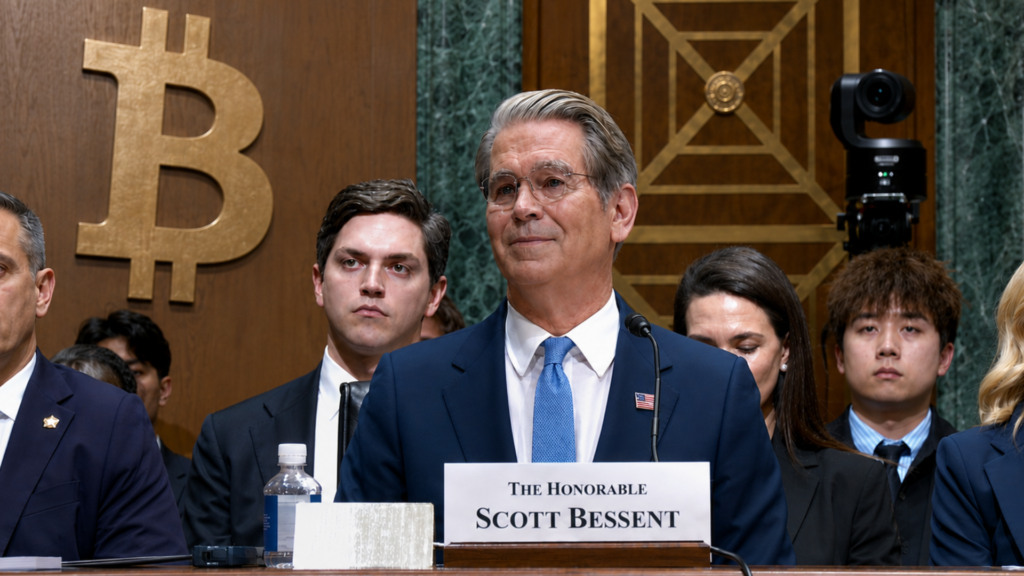
None of these is easy to execute, let alone sell politically. Treasury Secretary Scott Bessent — who chaired the G20 finance ministers’ meeting in North Carolina where much of this debate played out directly — has argued that stronger growth can help manage debt burdens over time. Several economists in the same debate have pushed back, arguing growth alone is unlikely to solve the problem without real changes to the underlying budget deficit.
That disagreement sits at the heart of the whole fiscal debate: can governments genuinely grow their way out of debt, or do they eventually have to make politically painful choices about spending and taxation regardless of the growth rate?
The Federal Reserve Is Part of the Equation
Markets are watching central banks just as closely as fiscal policy. In the U.S., persistent inflation — worsened directly by the oil shock from the Iran war — has complicated the outlook for interest rates considerably. A central bank that holds rates higher for longer can support currency confidence and help bring inflation down, but it also raises the government’s own borrowing costs in the process.
At the same time, ongoing political pressure for lower rates has created real uncertainty about how independent U.S. monetary policy will remain going forward — uncertainty that matters enormously to investors buying debt that won’t mature for ten or thirty years, since they need some confidence about what inflation, monetary policy, and fiscal policy will actually look like that far out. When those answers become less predictable, investors respond by demanding a larger risk premium up front.
Why Rising Yields Matter to Ordinary People
The bond market can feel abstract and distant from everyday financial life. It isn’t. Government bond yields set benchmarks for borrowing costs throughout the broader economy — when they rise, businesses face higher financing costs, mortgage rates climb, and auto loans and other consumer credit get more expensive across the board.
Higher government interest payments also squeeze public budgets directly: every dollar spent servicing debt is a dollar that can’t simultaneously fund infrastructure, healthcare, defense, education, or tax relief. That’s the less visible cost of rising yields, and it shows up in budget documents well before most people notice it in their own borrowing costs.
The Global Warning Is Bigger Than the U.S.
The most important signal from today’s bond markets may be broader than the American debt debate specifically. Japan is carrying a massive, historically unprecedented debt burden relative to its economy. European governments face their own distinct fiscal pressures. The UK is navigating genuinely difficult budget trade-offs with historically high borrowing costs squeezing an already-thin margin for error.
The United States is running historically large deficits alongside a rapidly growing interest bill. These countries aren’t identical, but they’re all bumping against the same basic constraint at nearly the same moment: borrowing is no longer nearly as cheap as it was for most of the past fifteen years, and a real geopolitical shock has arrived at precisely the moment that shift was already underway.
The End of the “Free Money” Era?
The world may be entering a period where fiscal discipline matters considerably more than it did during the era of ultra-low rates. That doesn’t necessarily mean governments must slash spending immediately — it does mean policymakers are increasingly confronting trade-offs that were much easier to postpone when borrowing cost next to nothing. Every additional dollar of debt now carries a real, rising financing cost, and every percentage-point increase in borrowing costs eventually shows up as a larger interest bill — with the effect scaling directly with the size of the existing debt pile. That’s why this year’s bond-market movements deserve serious attention even without an imminent crisis: markets have a track record of sending warnings well before governments are actually forced into action.
The Biggest Risk Is Losing Time
The greatest danger here probably isn’t a sudden collapse — it’s years of gradually rising interest costs compounding quietly in the background. A government can keep borrowing for a long stretch even while debt grows faster than the underlying economy, but eventually, servicing that debt consumes a growing share of public resources, and the available choices narrow. Taxes may need to rise. Spending may need to fall. Growth may need to accelerate meaningfully. Some combination of all three may become genuinely unavoidable. The longer governments wait to confront that reality, the harder those eventual choices tend to get.
The Bond Market Is Asking a Simple Question
This year’s bond-market turbulence isn’t proof that a global debt crisis is imminent. It is a clear signal that investors are paying much closer attention to the underlying numbers: how large are government deficits, how much debt is outstanding, how fast are interest payments growing, how persistent is this latest bout of oil-driven inflation, and — perhaps most importantly — do policymakers have a credible plan for managing all of it over the years ahead?
Those questions are becoming harder to avoid in Washington, Tokyo, London, Berlin, and Paris simultaneously. The era of borrowing without real consequences may not be completely over. But the bond market, in a matter of weeks in late summer 2026, made one thing considerably clearer than it’s been in years: governments can postpone fiscal decisions, but they cannot make the cost of debt disappear.
Author