The AfD’s breakthrough in Saxony-Anhalt has revived an old question about eastern Germany. But the forces behind its rise are not confined to the former East — and neither is the collapse of the party that used to dominate there.
Germany has spent decades debating how different its eastern and western states really are, politically. The Sept. 6 election in Saxony-Anhalt didn’t answer that question so much as make it impossible to set aside.
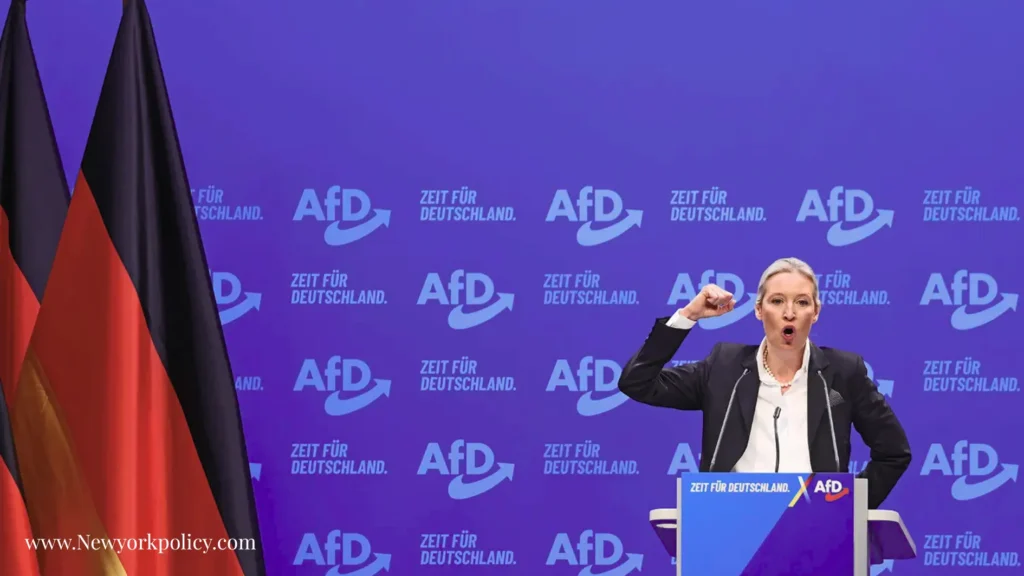
The Alternative for Germany, or AfD, won 43.8% of the vote — more than double its result five years earlier — and took 39 of the 83 seats in the state parliament. That left it three seats short of the 42 needed to govern alone, in a state where it would have been the first far-right party to run a German state government since World War II.
The headline number is the AfD’s. But the more revealing number may belong to the CDU, the party that had governed Saxony-Anhalt for 24 years. It collapsed from 37.1% of the vote in 2021 to 17.2% — losing more than half its support and 25 of its 40 seats in a single election. The Greens, by contrast, posted their best-ever result in a Saxony-Anhalt state election. A new party, the Sahra Wagenknecht Alliance (BSW), entered parliament for the first time with 5.3%. This wasn’t a uniform lurch to the right so much as a wholesale collapse of the political center.
The East-Germany Explanation Is Not Enough on Its Own
The standard account of AfD strength in the east points to the legacy of the former German Democratic Republic — the idea that decades of authoritarian rule left the region more receptive to strongman politics. There’s something to that history. But it doesn’t fully hold up as an explanation.
The AfD was founded in western Germany, and its leadership and activist base span both sides of the old border. Whatever is happening in Saxony-Anhalt isn’t a purely eastern phenomenon finding local expression — it’s a national movement that happens to be performing best in parts of the east.
Reunification Left More Than an Economic Scar
Germany’s 1990 reunification triggered rapid privatization and restructuring of the East German economy, much of it carried out through the Treuhand agency. Most former East German state enterprises ended up under West German or international ownership, and millions of jobs disappeared in the process.
For a generation of East Germans, reunification therefore became bound up with both new freedom and real loss — unemployment, out-migration, and the disappearance of once-familiar industries and institutions. Those experiences don’t need to still be economically accurate today to remain politically potent; folk memory of disruption can outlast the disruption itself.
Feeling Unheard Matters as Much as the Balance Sheet
Economic data alone doesn’t explain political behavior. Whether people believe their communities are taken seriously matters just as much — and that feeling is often sharpest in smaller towns and rural areas that have lost population and younger residents over decades.
A party doesn’t need voters to agree with its entire platform. It only needs enough of them to believe it’s the one actually listening to their frustration. That’s a lower bar, and it helps explain why support can hold even among voters who disagree with parts of a party’s program.
“Taking Back Control” Was the Message — but Not the Only Motive
The dominant theme of the AfD’s Saxony-Anhalt campaign was a version of “taking back control” — the idea that decisions affecting people’s daily lives were being made somewhere far away, by people who didn’t understand local conditions.
That message doesn’t sort voters into one bloc, though. Some are primarily animated by immigration. Others by energy prices, economic anxiety, or a general verdict on Berlin. Some are simply punishing every established party at once — which the scale of the CDU’s collapse suggests was happening here alongside any ideological shift. Treating “the AfD voter” as a single type flattens what was almost certainly a coalition of very different grievances arriving at the same ballot box.
The West Isn’t a Bystander in This Story
If the AfD’s appeal were purely a product of East German history, its national growth over the past decade would be hard to explain. It isn’t just an eastern party that occasionally polls well in the west — it has built genuine support across the country, including in Germany’s wealthier southern and western states.
That matters because it means Germany’s political establishment can’t treat the AfD as a regional containment problem. Immigration, economic uncertainty, housing costs, energy prices, and distrust of institutions don’t respect the old inner-German border.
The Divide Is Real, and It’s Also Changing
More than three decades on, the generation that lived through the division is aging out of the electorate, and millions of Germans have grown up with reunification only as history. Yet measurable differences — income, business ownership, demographics, political attitudes — persist between east and west.
What’s changing is who carries those differences forward. A younger generation may inherit reunification’s economic and cultural residue without any personal memory of the wall coming down, which means the political meaning of “eastern Germany” is likely to keep shifting rather than settle into a fixed identity.
A Landslide, Not a Monolith
It would be a mistake to read 43.8% as evidence that eastern Germany has become politically uniform. Most voters in Saxony-Anhalt didn’t vote AfD. The CDU, SPD, Greens, Left and now BSW all hold seats in the new parliament, and because the AfD fell three seats short of a majority, its vote share doesn’t automatically translate into governing power.
Every other party has ruled out forming a coalition with the AfD — a version of the “firewall” that has held, so far, in every German state where the party has performed strongly. (The AfD’s state branch in Saxony-Anhalt is also under surveillance by Germany’s domestic intelligence service, the Federal Office for the Protection of the Constitution, which classifies it as confirmed far-right.)
That firewall now faces its hardest test yet: with the center reduced to a fraction of its former strength, assembling any stable governing majority without the AfD will require parties that have little in common — the CDU, SPD, Greens and Left — to somehow govern together.
Refusing to Cooperate Has a Cost of Its Own
That creates a genuine bind. If mainstream parties continue excluding the AfD, the party can credibly argue that more than four in ten voters are being shut out of power altogether. If they cooperate, even informally, they risk dissolving the boundary that has defined mainstream German politics since the AfD’s founding. Neither option is free, and Saxony-Anhalt is where that tradeoff stops being theoretical.
The Deeper Warning Is About Trust, Not Geography
The most important lesson from Saxony-Anhalt may have less to do with east and west than with what happens when a very large share of voters stop believing the establishment represents them. That pattern isn’t unique to Germany — legacy parties are losing ground across much of Europe to movements that were, until recently, treated as fringe.
The result is also a national political story, not just a state one: it lands as a direct blow to Chancellor Friedrich Merz’s federal government, whose center-right party has now lost its flagship eastern stronghold at a moment when it has yet to convince voters it can revive a sluggish national economy.
The Governing Fight Matters More Than the Exit Poll
A striking election-night number is not the same as a governing mandate. The AfD doesn’t have a majority, and the parties that collectively do will spend the coming weeks negotiating whether — and how — they can form a government at all.
Whether they can address the grievances that hollowed out the CDU’s support, rebuild trust in places that feel overlooked, and compete with the AfD without adopting its platform wholesale will matter more, in the long run, than the 43.8% headline. None of that will be settled by a single election night.
The Map Has Moved Past East and West
Germany’s old political map was drawn around a border that disappeared in 1990. The new one is organized around different lines entirely: economic opportunity, urban versus rural experience, trust in institutions, and whether government feels like it understands ordinary life. Those divisions run through both halves of the country.
Saxony-Anhalt’s result isn’t simply a story about the former East, and it isn’t simply a story about the AfD’s rise — it’s also the story of how fast an establishment party can lose half its support once voters decide it no longer speaks for them. Germany has spent thirty-five years asking whether East and West have truly become one country. The sharper question now is whether its governing parties can convince voters, anywhere in Germany, that they still understand the country those voters actually live in.
Author