Canada is exploring an unprecedented relationship with the European Union, from trade and defense to artificial intelligence and energy. The idea is gaining momentum — but the details, legal structure, and economic consequences remain unsettled.
Canada and the European Union are discussing a relationship that neither side has ever had before. Canadian Prime Minister Mark Carney used an address to the European Parliament on Thursday to endorse deeper ties with Europe, while drawing a clear line between cooperation and full EU membership.
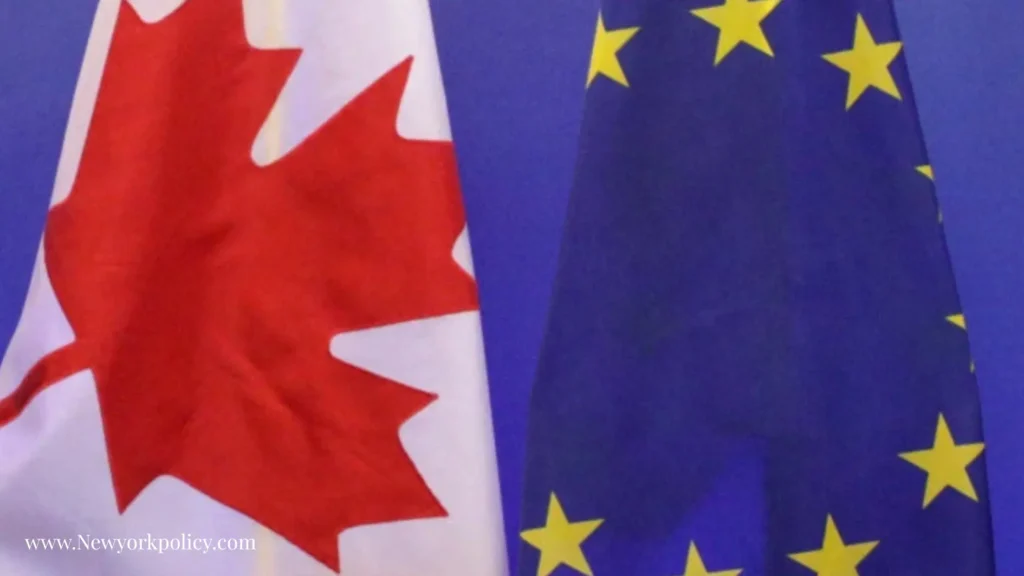
The discussion follows European Commission President Ursula von der Leyen’s proposal for Canada to become the European Union’s first “associate member” — a term with no established status under the EU’s existing treaties, meaning the substance of any arrangement would have to be negotiated essentially from scratch.
For Canada, the proposal could eventually touch trade, energy, defense, technology, education, and critical minerals. For Europe, it raises a different question: how far can the EU extend its strategic partnerships beyond its own membership without creating an entirely new category of obligations?
This Is Not EU Membership
Carney was careful to separate the proposal from joining the European Union outright. Canada, he said, is neither seeking nor positioned to become a full EU member; Ottawa instead wants a framework that deepens cooperation while preserving Canadian sovereignty. That distinction matters, because EU membership comes with extensive obligations tied to the single market, EU law, and the bloc’s institutions — an associate arrangement would have to look like something else entirely.
What that something else actually is hasn’t been decided yet. Carney said the precise terminology was ultimately a matter for Europe to sort out, while stressing that the substance of the relationship mattered more than its name. That leaves considerable room for negotiation on both sides.
The Relationship Is Bigger Than Trade
Trade remains one of the foundations of the relationship, but it’s no longer the only focus. Canada and the EU already have the Comprehensive Economic and Trade Agreement (CETA), provisionally applied since 2017; EU data show bilateral trade in goods and services reached about €130 billion in 2025, up substantially from 2016. The two sides are also negotiating a digital trade agreement, with talks formally launched in March 2026.
The proposed deeper partnership could build on top of those existing arrangements. Carney identified several additional areas for cooperation, including critical minerals, energy security, defense production, artificial intelligence, financial systems, and space — a scope considerably broader than what people usually mean by a free-trade partnership.
Critical Minerals and Energy Could Be Central
Canada holds resources that Europe increasingly considers strategically important, including critical minerals and energy commodities. Closer cooperation could give European companies greater access to Canadian supplies while opening additional markets and investment for Canada in return. Carney has also pointed to liquefied natural gas and hydrogen as areas where Canada could contribute directly to European energy security.
The broader goal on both sides is diversification. The EU has spent years trying to reduce vulnerabilities in its strategic supply chains, while Canada has been looking for ways to expand its economic relationships beyond its enormous dependence on the United States. A stronger Canada-EU relationship could serve both interests at once, without requiring either side to walk away from existing partnerships.
Defense Is Moving Into the Conversation
Defense is another area where the relationship could become more consequential. Carney has proposed deeper cooperation in defense production, and Canada has also moved toward greater involvement with European security initiatives more broadly.
The point isn’t necessarily to create a separate military alliance. Cooperation could instead involve industrial capacity, procurement, technology, and coordination among countries that already participate in the broader Western security architecture. That distinction matters: Canada remains part of NATO, and the European Union isn’t a substitute for NATO either. A deeper Canada-EU relationship would operate alongside those existing institutions rather than replacing them.
Artificial Intelligence Adds a New Dimension
Carney also named artificial intelligence as an area for cooperation, including the possibility of jointly developing AI safety protocols — a sign of just how quickly technology has become part of international economic and security policy. For Canada and Europe, that cooperation could touch standards, research, computing infrastructure, digital trade, and the rules governing emerging technologies.
The complication is that technology policy tends to get tangled up quickly with questions of national competitiveness. Any Canada-EU framework would have to balance genuine cooperation against each side’s interest in retaining control over its own strategic technologies.
The United States Still Matters
All of this is unfolding against a difficult stretch in Canada-U.S. relations. President Donald Trump has warned that Europe could face heavy tariffs if Washington views the Canada-EU arrangement as a hostile move. Carney has rejected the idea that Canada and Europe are building a bloc meant to confront the United States, arguing instead that greater resilience doesn’t require isolation.
That distinction may matter more and more as Ottawa negotiates with Washington while simultaneously expanding its relationships with Europe and other partners. Canada’s economy remains deeply tied to the United States, and building new relationships elsewhere doesn’t erase that dependence overnight — it mainly gives Canadian businesses and policymakers more options than they had before.
Europe Has Its Own Reservations
European governments aren’t automatically on board with the proposed associate-member structure. The concept itself is new, and EU officials and diplomats have already raised questions about what such a status would mean in practice — the legal and institutional details would still have to be worked out among the EU’s member states.
There are existing obstacles too. CETA has been provisionally applied for years, but ratification by all EU member states still hasn’t been completed, which shows how complicated even the current Canada-EU arrangement can get once national and EU-level interests start to overlap. A much broader partnership would inevitably raise a longer list of open questions: which EU programs would Canada actually participate in? How much regulatory alignment would be required? Would Canadian companies gain additional access to European markets? How would disputes get resolved, and what obligations would each side ultimately accept?
None of that has been settled.
The Next Test Comes in Montreal
This is an early-stage proposal, not a finished agreement. Carney said the final structure would ultimately be debated and voted on by Canada’s Parliament, and the next major opportunity to define the relationship is expected at the Canada-EU summit in Montreal later this year. That means the current headlines may matter less than the negotiations that follow them.
The phrase “associate member” has grabbed attention because it sounds like a brand-new category of European membership. But the real story is broader than the label. Canada and Europe are exploring whether they can build a relationship that combines trade, strategic resources, defense, technology, education, and political cooperation — without turning Canada into an EU member or creating a formal third geopolitical bloc. Whether that model actually works will come down to the details, and those details are exactly what Canada and Europe are just beginning to negotiate.
Author