Clean energy has changed some of the worst climate projections. But new modeling suggests that a world of roughly 3°C warming remains possible — and uncertainty could still push the outcome much higher.
For years, climate change was often presented through its most extreme scenarios: fossil-fuel use climbing indefinitely, coal consumption exploding, a world warming four or five degrees Celsius by century’s end. Some of those scenarios have quietly become far less plausible — and the retirement of the specific pathway that anchored them just became, in the words of one recent analysis, “official.”
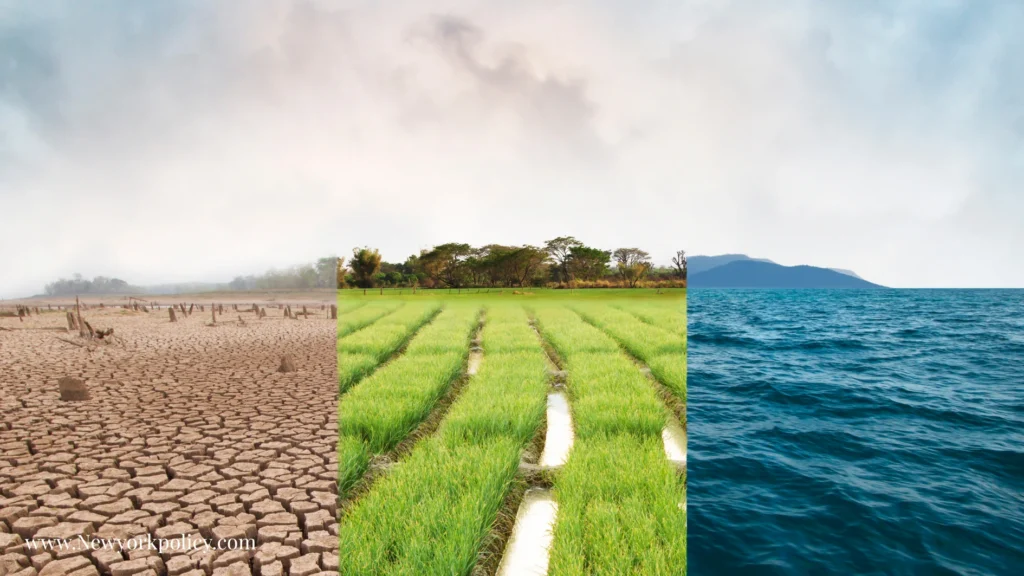
The global energy system has genuinely changed. Solar and wind have expanded faster than most models assumed, batteries have gotten dramatically cheaper, coal consumption has stopped growing the way older scenarios projected, and clean-energy investment has risen substantially. That shift shows up directly in the latest generation of global climate modeling, known as CMIP7, published this year by researchers led by Detlef van Vuuren. The new medium scenario — roughly representing today’s actual policy trajectory — produces a central estimate of about 2.9°C of warming by 2100.
That leaves the world in a genuinely uncomfortable middle ground: meaningfully better than the worst old projections, and still nowhere close to good.
The Worst-Case Scenario Has Changed
The most consequential shift is what scientists are no longer assuming by default. Earlier scenario generations included pathways with dramatically escalating global coal use — most famously RCP8.5, developed in 2011 and long treated as a benchmark “worst case” in both scientific literature and popular climate coverage. RCP8.5 projected 4.9°C of warming by 2100; the SRES A1FI scenario before it, used in the IPCC’s 2001 and 2007 reports, projected 4.6°C.
CMIP7’s new high-end scenario comes in well below both. Per Carbon Brief’s analysis of the new framework, the CMIP7 High scenario is roughly 0.9°C cooler than its CMIP6 predecessor (SSP5-8.5) in directly comparable terms, and about 1.4°C cooler than the equivalent scenario used in the IPCC’s most recent assessment report.
In raw emissions terms, the new High scenario reaches about 71 gigatons of CO2 per year by 2100 — far below SSP5-8.5’s 128 gigatons. As one widely circulated technical analysis of the change put it bluntly: “the implausibility of upper-end legacy scenarios is now official.” Real-world global emissions have flattened out rather than following RCP8.5’s assumed trajectory — they aren’t falling, but they’re tracking closer to considerably more modest older pathways.
That’s genuine, measurable progress reflecting real developments in the global energy system. But a lower ceiling on the worst case is not the same thing as a low overall risk — the middle of the new range is still deeply serious.
A 2.9°C World Is Still a Major Change
The CMIP7 scenario most closely tied to something like current policy trajectories produces that central estimate of roughly 2.9°C of warming by 2100. Its uncertainty range is genuinely wide — one authoritative estimate puts it at roughly 2.2°C to 3.9°C, reflecting real scientific uncertainty about future emissions, technology, policy, and how the climate system itself responds to the greenhouse gases already being added to it.
That range matters enormously for how the number should be read. Climate projections are conditional estimates, not fixed predictions of one inevitable future — they describe what happens under a specific bundle of assumptions, and those assumptions can and do shift as policy, technology, and global energy markets change. The 2.9°C figure is not a forecast of a preordained outcome. It’s a snapshot of where current trends point if nothing meaningfully changes from here.
The Biggest Surprise May Be the Uncertainty
Even a more sophisticated generation of climate models doesn’t eliminate genuine physical uncertainty. Earth’s climate involves deeply interacting systems — oceans, clouds, ice, vegetation, atmospheric chemistry, the carbon cycle — several of which can amplify warming beyond what a simple emissions-to-temperature conversion would suggest. Melting snow and ice reduce how much sunlight the planet reflects into space. Changing forest patterns and wildfire frequency affect how much carbon the land absorbs versus releases. Warmer oceans change how much heat and CO2 they can continue taking up over time.
Researchers are increasingly studying not just how much greenhouse gas humans emit, but how the planet itself responds to those emissions — and CMIP7’s own scenario framework is explicitly designed to fold carbon-cycle uncertainty directly into its emissions-driven model runs going forward, rather than treating it as a separate afterthought layered on top.
Notably, even the CMIP7 medium scenario — the one producing that 2.9°C central estimate — still carries roughly a 3 percent chance of exceeding 4°C by 2100, according to Carbon Brief’s analysis; if emissions continue on that same trajectory beyond century’s end, those odds rise to roughly 25 percent by 2150. That’s a meaningful tail risk sitting underneath an already serious central estimate, and it cuts only in one uncomfortable direction: toward more warming, not less, in the scenarios where things go worse than the median case.
3°C Changes the Conversation
International climate diplomacy has spent years organized around keeping warming below 2°C, with 1.5°C treated as the more ambitious aspirational target. The latest projections make both goals considerably harder to square with where current policy actually points. Carbon Brief’s analysis of the CMIP7 medium scenario finds it crossing 2°C around the middle of this century and reaching roughly 3°C in the following century if the underlying trajectory holds.
That doesn’t mean a 3°C future is locked in — it means that current policy, essentially frozen in place at today’s ambition level, doesn’t put the world on a path consistent with the Paris Agreement’s most ambitious goals. And the difference between 2°C and 3°C isn’t simply another degree on a thermometer in any linear sense.
Higher average warming changes the underlying risk profile for agriculture, water systems, coastal communities, ecosystems, and human health in ways that don’t scale smoothly — some impacts become disproportionately harder to adapt to as temperatures climb, rather than proportionally harder. The live scientific and policy question isn’t whether continued warming carries real harm. It’s how much additional risk societies are actually choosing to accept by not accelerating the current trajectory.
El Niño Adds Another Complication
The near-term temperature picture is also shaped by natural variability layered on top of the long-term trend. A rapidly developing El Niño pattern has been influencing global temperatures and weather through 2026, and climate monitors have flagged a real chance this year could rank among the warmest in the instrumental record, with the following year potentially even warmer as the El Niño’s full influence plays out.
Events like El Niño don’t create the underlying long-term warming trend — they temporarily amplify or moderate it on top of whatever the baseline trajectory already is. That makes any single year genuinely tricky to interpret in isolation: an unusually hot year doesn’t prove long-term warming has suddenly accelerated past what models expect, and a temporarily cooler year wouldn’t prove warming has somehow stopped either. The multi-decade trend, not any individual year’s headline number, remains the measure that actually matters for the CMIP7 projections themselves.
The Energy Transition Has Bought Time. It Has Not Finished the Job.
The most genuinely encouraging part of the new projections is that the global energy system has moved measurably away from the most carbon-intensive pathways once treated as serious, central possibilities. That’s real, and every fraction of a degree of avoided warming reduces some concrete climate risk somewhere in the world.
But the remaining gap between where current trends point and where climate goals sit is still large. Even the “current policy” scenario in CMIP7 runs considerably warmer than the Paris Agreement’s stated long-term goals, and the high-end scenarios haven’t vanished — they’ve simply moved down from where they used to sit.
The new CMIP7 High scenario still reaches roughly 3.3°C by 2100 and keeps warming beyond that point under continued high emissions, and the CMIP7 scientific documentation is explicit that this high-end pathway “still leads to substantial climate change,” with genuine physical uncertainty leaving global warming exceeding 4°C by 2100 within the realm of documented possibility, not science fiction.
The relevant timelines can sound distant. The infrastructure decisions being made right now are not. Power plants, buildings, transportation networks, cities, and coastal development can all remain in place and in use for many decades — meaning choices made today shape both emissions and adaptation requirements long after the people making those decisions have left office.
The Climate Debate Should Move Beyond Two Extremes
There are two genuinely misleading ways to read this new generation of science. One is insisting nothing has actually changed and that the most extreme historical scenarios remain the realistic central case — they plainly don’t anymore, and treating RCP8.5-style outcomes as the expected future is no longer defensible given what CMIP7’s own documentation shows.
The other is concluding that technological progress has essentially solved the problem and the danger has substantially passed — the evidence doesn’t support that conclusion either, given that even the “improved,” policy-consistent central estimate still points toward roughly 2.9°C of warming with a meaningful chance of considerably more.
The more accurate picture sits between those two extremes. The world has made real, measurable progress — the energy transition has genuinely lowered the upper bound of plausible future warming, and some of the most catastrophic pathways once treated as serious possibilities are now considered implausible by the scientists who build these models. But the central pathway remains deeply disruptive by any historical standard, and real scientific uncertainty leaves the door open to substantially worse outcomes than the median projection alone would suggest.
The Next Decade Still Matters
Climate projections describe conditional futures, not fixed destiny — they’re built on choices about emissions and assumptions about technology, economics, and the climate system’s own physical response, all of which remain genuinely open questions rather than settled facts.
That’s exactly what makes the next phase of the global energy transition so consequential. If clean energy keeps expanding faster than currently assumed, emissions can fall more quickly and warming can be constrained further below the current 2.9°C central estimate. If fossil-fuel use stays elevated longer than expected, the risks compound in the other direction.
The genuinely encouraging news is that the world has already demonstrated, over roughly the past decade, that technological change can meaningfully bend the trajectory — CMIP7’s retirement of RCP8.5-scale outcomes as remotely plausible is itself proof of that.
The less encouraging news is that the trajectory the world is currently on, even after that real progress, still points toward a level of warming that would meaningfully reshape agriculture, water availability, coastal life, and public health in large parts of the world.
The climate outlook, in other words, is neither a story of inevitable catastrophe nor one of quiet victory. It’s a narrowing window of real, live choices — and the most important number in this entire body of research may not be the temperature any particular model ultimately projects. It may be how quickly the world actually moves the emissions pathway that determines, in the end, which of these seven CMIP7 futures becomes the real one.
Author