Trump’s U.N. Speech Was Built on Big Claims. The Numbers Tell a Different Story

From oil reserves and drug trafficking to Gaza and the wars he says he helped end, President Trump used the United Nations stage to present an expansive record of achievement. Several of his most striking claims do not line up neatly with the available evidence.
President Trump addressed the United Nations General Assembly on Tuesday, September 22, 2026 — his first appearance there since the U.S. went to war with Iran, and seven months into a foreign-policy stretch he clearly intended to present as historic. He told the assembled world leaders he had helped “end the war in Gaza, saving untold thousands of lives,” brought home “all remaining hostages, both living and dead, every single one of them,” and — pushing his running tally higher than ever before — claimed to have personally settled eight wars during his time in office.
Several of the speech’s most striking numbers don’t hold up well against the available evidence.
The Oil Claim Is Far Larger Than the Numbers
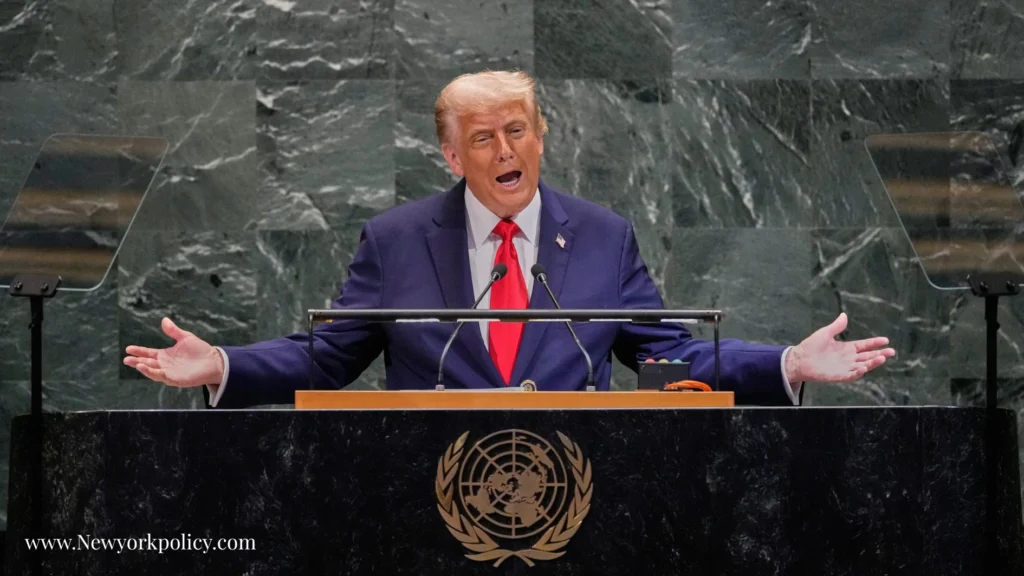
One of Trump’s most eye-catching lines concerned Venezuela. “When you add the United States and Venezuela together, we have more than 60% of the oil in the world,” he told the Assembly — before adding, strikingly, “it was a war, but it’s perhaps the biggest deal ever made. To the victor belong the spoils.”
The reserve figures don’t support that math. Venezuela holds roughly 303 billion barrels of proven crude reserves; the U.S. holds roughly 46 billion. Combined, that’s about 349 billion barrels — against global proven reserves of close to 1.6 trillion barrels. That puts the U.S.-Venezuela combined share at roughly one-fifth of the world’s proven reserves, not “more than 60%.”
There’s a second layer worth flagging here too: Trump’s framing of the underlying Venezuela operation itself has shifted dramatically since it happened. In January, when the U.S. military captured Nicolás Maduro in Caracas, the administration explicitly described it as a narrow law-enforcement action — U.N. Ambassador Michael Waltz told the same institution at the time that “there was no war against Venezuela or its people” and that the U.S. was “not occupying” the country.
On Tuesday, Trump described the same operation as “a war” involving a “massive military operation, penetrating deep into the Venezuelan capital,” through a “heavily defended and fortified military base, one that was supposed to be flawless against attack” — and explicitly invoked “to the victor belong the spoils” to justify American claims on Venezuelan oil. That’s a considerable reframing of an eight-month-old event, from limited law enforcement to conquest, delivered from the U.N. podium itself.
Gaza: A Cease-Fire Is Not the Same as the End of a War
Trump’s claim that his administration “ended the war in Gaza” and “brought home all remaining hostages… every single one of them” describes something real but overstated. The ceasefire and hostage-release agreement, which took effect October 10, 2025, is a genuine diplomatic achievement — hostages have come home, a surge of humanitarian aid has moved into Gaza, and Israeli forces have partially pulled back from major cities.
But independent fact-checkers, including PolitiFact and the Associated Press, have repeatedly noted that major elements of an actual, durable resolution remain unresolved: disarming Hamas, standing up a post-war governing structure for Gaza, funding and executing reconstruction, and determining the extent of any further Israeli withdrawal.
Hamas has separately threatened to halt cooperation with the agreement over aid-access disputes, and Israel has said it won’t move into the deal’s more difficult second phase until the remains of the final hostage are returned. A ceasefire that’s largely holding is a genuinely significant, measurable diplomatic result. Declaring the underlying war definitively “ended” describes a considerably higher bar that the facts on the ground haven’t yet cleared.
The “Eight Wars” Claim Keeps Growing — And Fact-Checkers Keep Flagging It
Trump’s running count of wars he’s personally settled has become something of a moving target. At the U.N. a year earlier, in September 2025, he claimed seven — listing Cambodia-Thailand, Kosovo-Serbia, Congo-Rwanda, Pakistan-India, Israel-Iran, Egypt-Ethiopia, and Armenia-Azerbaijan. PolitiFact rated that claim “Mostly False” at the time, and rated an even earlier “six wars” version the same way. By this week, with the Gaza ceasefire added to the list, Trump had bumped the total to eight, telling Israel’s Knesset in October, “Yesterday I was saying seven, but now I can say eight.”
The Associated Press’s own fact-check of the “eight wars” claim, published this week, found the number “off” for several concrete reasons: fresh fighting had broken out in recent weeks between Thailand and Cambodia and between Congolese forces and Rwanda-backed rebels — meaning at least two of the supposedly “ended” conflicts had already resumed by the time Trump repeated the claim.
The AP also noted that one of the conflicts on Trump’s list “has never been a war at all.” Trump did play a real, credited role in several genuine ceasefires — Evelyn Farkas of Arizona State University’s McCain Institute has said he deserves real credit for helping end the 12-day Israel-Iran war in June, for instance. But “helped negotiate a ceasefire” and “settled a war permanently” are meaningfully different claims, and the gap between them is exactly where most of these fact-checks land.
The Drug Trafficking Numbers Trace Back to a Different Speech
Trump’s claim about maritime drug interdiction — that U.S. strikes on suspected cartel vessels had “knocked out 97 percent of the drugs coming in by sea” and that trafficking had fallen by roughly 90 percent — isn’t new to Tuesday’s speech.
He used nearly identical language back on January 3, 2026, in his initial remarks announcing the Venezuela operation, telling reporters “we’ve knocked out 97 percent of the drugs coming in by sea, 90 percent” and, oddly, that “each boat kills, on average, 25,000 people” — a claim about lethality per vessel that doesn’t correspond to any standard measure of drug harm and appears to conflate the number of people a boat’s cargo might theoretically supply with an actual death toll.
The administration has pointed to changes in seizure data as evidence for the trafficking decline, but seizures measure what’s been caught, not the total volume moving through undetected — a decline in seizures is equally consistent with reduced trafficking or with traffickers adapting their routes and methods. Independent reporting has documented exactly that kind of adaptation happening.
Separately, a United Nations expert report has raised serious legal concerns about the underlying strike campaign itself, finding that dozens of attacks on suspected trafficking vessels had killed more than 200 people — a finding about the campaign’s legality and human toll, not a measurement of how much trafficking volume has actually changed.
The Iran Death Toll Claim
Trump’s speech also included a specific casualty figure that fact-checkers flagged immediately: an accusation that the Iranian government had killed 72,000 people so far this year. That figure doesn’t correspond to any documented casualty count from the ongoing conflict that independent monitors have published, and outlets covering the speech in real time noted it among several claims made without clear sourcing.
The Numbers Matter Because the Audience Matters
A U.N. General Assembly address isn’t a campaign rally — the audience includes foreign governments, career diplomats, international organizations, and allied and rival states alike, all of whom treat statements from that podium as data points about actual American policy and intent, not just political messaging for a domestic audience. That raises the stakes on precision considerably.
Saying the U.S. and Venezuela together hold “more than 60%” of world oil reserves creates a fundamentally different impression than the accurate figure of roughly one-fifth. Saying maritime drug trafficking has fallen 97 percent implies a near-total transformation of the market, when the underlying evidence only supports claims about seizures and strikes, not total trafficking volume. And declaring a war “ended” implies a political settlement that, in Gaza’s case specifically, independent observers agree hasn’t actually been reached yet.
A Pattern, Not a One-Off
This wasn’t an isolated instance. Trump has used exceptionally large, often round figures to describe foreign investment, energy production, and diplomatic wins repeatedly throughout his term, and fact-checkers have flagged a recurring pattern: definitions that quietly broaden over time, future commitments described as already-delivered results, and comparisons that shift the meaning of the underlying data without changing the headline number.
The escalating “wars ended” count — six, then seven, then eight, even as some of the underlying conflicts visibly reignited — is a fairly clean illustration of exactly that pattern playing out over more than a year, tracked in close to real time by outlets including PolitiFact and the AP.
None of this means every claim in the speech was false, or that Trump’s foreign-policy record contains no real achievements — the Gaza ceasefire, the Israel-Iran truce, and several other agreements are genuine, credited diplomatic wins by independent assessment. It means the gap between what happened and how the president chose to describe what happened, on the world’s most closely watched diplomatic stage, was unusually wide even by the standards of past U.N. addresses.
The Bigger Issue Is Accountability
Presidents inevitably present their own records in the most favorable available light — that’s an ordinary feature of politics, not unique to this speech or this president. But international audiences, financial markets, and American voters ultimately need something more precise than a run of impressive-sounding round numbers to actually plan around.
How much oil is genuinely available, and to whom? How much has drug trafficking actually declined, measured against total volume rather than seizures alone? Has a ceasefire become an actual, durable peace? How many conflicts have truly been settled rather than merely paused? Those questions can’t be answered by rhetoric delivered from a podium, however confidently.
Tuesday’s speech was built to project strength and an unbroken record of success. The available evidence, gathered in real time by multiple independent fact-checking organizations within hours of the address, points to something considerably more complicated — one where real developments sit right alongside claims substantially larger than the underlying data can actually support. At the United Nations, as anywhere else, a country’s credibility ultimately rests not just on the power behind its message, but on whether the specific numbers in it can survive scrutiny.