While humanoid robots attract the headlines, China is quietly building something more consequential: a massive industrial robotics ecosystem designed around scale, cost, and real-world deployment.
Humanoid robots have become one of the most visible symbols of the AI boom. Videos of machines walking, dancing, and performing increasingly complicated movements rack up millions of views, and investors keep pouring money into companies building robots that move through the world the way people do.
But the most consequential robotics story right now may be happening somewhere far less glamorous: inside factories. Across warehouses, ports, hospitals, and production lines, China is deploying robots built for specific jobs at genuinely industrial scale — and the numbers, once you look at them directly, are hard to overstate. China’s edge in robotics may ultimately come not from building the most humanlike machine, but from doing what it has already done in EVs, batteries, and solar panels: manufacturing enormous quantities of increasingly capable products at prices nobody else can match.
The Robot Race Is Bigger Than Humanoids
The global robotics conversation has become dominated by humanoids, and the appeal is easy to understand — a robot with two arms, two legs, and a roughly human shape could theoretically operate in spaces built for people without requiring those spaces to be redesigned. But most industrial tasks simply don’t require a human body.
A robotic arm doesn’t need legs. A warehouse vehicle doesn’t need hands. A floor-cleaning machine doesn’t need a face. The most efficient robot for a given job is usually the one built around that specific task, not around human anatomy — and that’s precisely where China’s robotics industry has built its deepest advantage.
China Already Has an Enormous Industrial Base
China has spent a decade automating its manufacturing sector, and the scale is no longer close. According to the International Federation of Robotics’ World Robotics 2025 report, China installed 295,000 industrial robots in 2024 alone — 54 percent of the 542,000 units installed worldwide that year, and the highest annual total any country has ever recorded.
Its total operational stock now exceeds 2 million industrial robots, roughly 4.5 times Japan’s, which ranks a distant second. IFR’s preliminary estimate for 2025 puts Chinese installations at roughly ten times the U.S. total for the year, even as American installations recovered 11 percent to about 38,000 units.
That scale gives Chinese manufacturers something emerging competitors elsewhere simply don’t have: an enormous domestic proving ground. A company can develop a machine, deploy it across thousands of Chinese factories, find its weaknesses, iterate, and repeat the cycle at a scale no other market currently allows. It’s also increasingly a domestically built proving ground — Chinese suppliers’ share of their own home robotics market climbed from 30 percent in 2020 to 57 percent in 2024, the first year local manufacturers outsold foreign competitors on their own turf. In metal and machinery manufacturing specifically, Chinese suppliers now hold roughly 85 to 90 percent of the domestic market.
The Real Advantage May Be the Supply Chain
Building an advanced robot takes far more than AI — motors, sensors, controllers, gear systems, batteries, cameras, semiconductors, and precision mechanical components, plus the manufacturing expertise to assemble all of it reliably at volume. China already runs deep, integrated supply chains across nearly all of those categories, which sets up a genuine feedback loop: more robots create more component demand, more component production drives costs down, lower costs make automation more attractive, and larger markets give manufacturers more chances to refine their products further. This is the same pattern China has run in electric vehicles, batteries, and solar — the country’s edge usually isn’t one breakthrough technology, it’s the ability to scale an entire ecosystem simultaneously.
That said, the ecosystem isn’t fully self-contained yet. Japan still supplies an estimated 35 to 45 percent of the high-value components inside China’s own robotics industry — precision items like ball screws and high-parameter gear and transmission devices — which is exactly why China’s new Five-Year Plan explicitly targets domestic breakthroughs in those categories. Closing that remaining gap is now a stated national priority, not an afterthought.
The Quiet Rise of Specialized Robots
The most consequential machines in this story are unlikely to ever go viral. Autonomous mobile robots move goods through warehouses; automated guided vehicles shuttle materials around factories and ports; robotic arms assemble products with extraordinary consistency; specialized machines handle repetitive inspection and packaging; surgical robots assist with highly precise procedures. None of this is exciting to watch. All of it is easy to measure economically — it reduces repetitive labor, improves consistency, runs continuously, and makes factories more competitive on cost.
Ports Are Becoming Robotics Laboratories
The transformation extends well beyond factory floors. Chinese ports have become some of the largest automated-logistics environments on Earth — automated vehicles move containers, remote-controlled cranes handle cargo, and software coordinates operations across sprawling facilities. That matters economically because ports sit at the center of global trade flows: if China can build cheaper, more capable automation for factories, warehouses, and ports alike, it isn’t just exporting robots — it’s positioning to export entire automation systems as a package, which is a considerably bigger commercial opportunity than selling individual machines.
China Is Also Racing Ahead on Humanoids — Just Differently
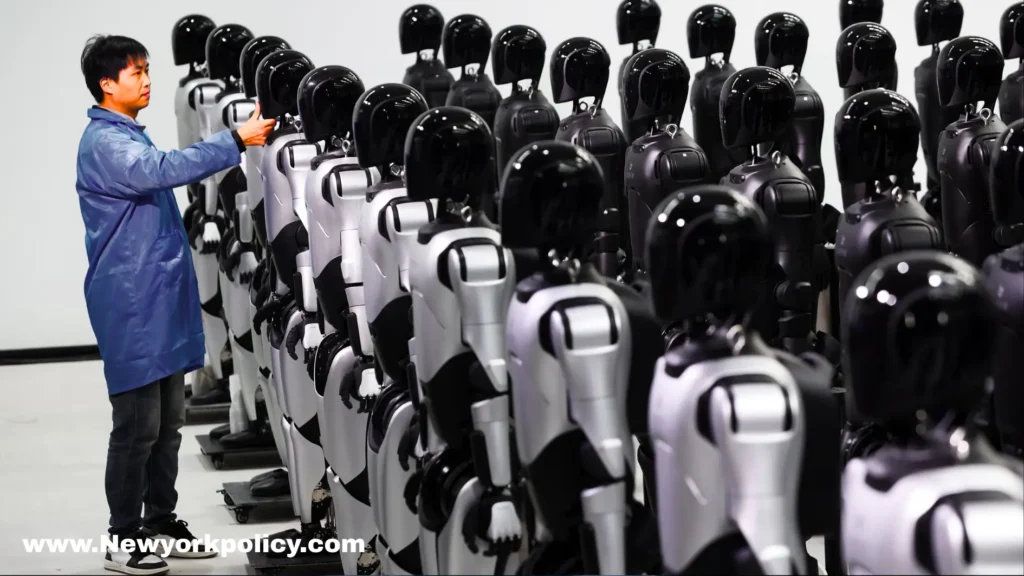
It would be a mistake to read China’s industrial focus as disinterest in humanoids. The opposite is closer to true: Chinese firms shipped roughly 90 percent of the world’s humanoid robot units in 2025, led by AgiBot (5,168 units), Unitree (over 4,200), and UBTech. In March 2026, China opened its first fully automated humanoid production line, in Foshan, Guangdong — 24 digitalized assembly processes and 77 safety tests turning out one finished robot roughly every 30 minutes, with annual capacity for 10,000 units and efficiency gains of more than 50 percent over earlier manual methods. Unitree is targeting up to 20,000 shipments in 2026; UBTech is targeting 10,000, having already delivered more than 500 of its Walker line.
But China’s own policy roadmap treats humanoids as a longer-horizon bet, not the near-term payoff. The newly adopted 15th Five-Year Plan (2026–2030) places robotics at the center of China’s industrial strategy — explicitly directing AI research toward physical, real-world applications — but IFR’s own analysis of the plan notes that it expects wide industrial AI adoption within five to ten years, while treating full humanoid commercialization as a goal for the back half of that window, not the front. In other words: Beijing is racing on humanoids, but it isn’t betting the whole strategy on them arriving first.
AI Could Change the Equation — And China Is Building the Rules Around It
Traditional industrial robots excel at repetitive tasks in tightly controlled environments and struggle the moment conditions change — a box moved, an object out of place, a person entering the workspace. AI is what could close that gap, letting engineers train machines to interpret unfamiliar situations rather than pre-programming every possible movement.
If that shift happens at scale, industrial robotics starts looking less like a collection of narrow automation tools and more like something closer to general-purpose physical labor — and humanoids become commercially far more interesting in the process.
China isn’t just chasing that shift technically; it’s moving to set the rules around it. The Ministry of Industry and Information Technology established a dedicated Humanoid Robot and Embodied Intelligence Standardization Technical Committee in December 2025, and by March 2026 had already released the first national standard system covering the humanoid robot industry’s full lifecycle. China is separately leading the formulation of international standards for elder-care robots through the IEC. That’s the same playbook China ran with 5G and high-speed rail: establish the domestic standard first, build scale around it, then push it outward as the de facto global norm.
China Has Another Advantage: Deployment
One of China’s clearest advantages may simply be its willingness to put automation to work at scale rather than perfecting it in a lab first. Robotics improves through use — a machine that logs thousands of real operating hours generates data on which components fail, which tasks prove genuinely difficult, and where software and maintenance need to improve. China’s enormous manufacturing base gives that feedback loop an unusually large environment to run in continuously, which is arguably more valuable over time than any single impressive demonstration.
The Next Competition May Be About Cost
For years, technological competition got framed around who could build the single most advanced machine. Robotics is introducing a different question: who can make capable robots cheap enough for millions of ordinary businesses to actually buy? That’s the terrain where China’s manufacturing model is strongest. A theoretically superior robot that costs several times more can lose out to a simpler one that does the job at a fraction of the price — industrial buyers generally care about cost, reliability, installation speed, and payback period far more than technical sophistication for its own sake. The most exciting robot isn’t necessarily the most valuable one. The most valuable robot is usually the one that pays for itself fastest.
Western Companies Face a Genuine Strategic Challenge
China’s rise creates a real competitive problem for the U.S., Europe, and Japan, home to long-established industrial robotics leaders like Japan’s Fanuc, Switzerland’s ABB, and Germany’s KUKA. Chinese manufacturers are gaining deep experience in an enormous home market while increasingly pushing abroad — Shenzhen-based Pudu Robotics, for instance, has already opened U.S. operations. If Chinese firms become genuinely competitive not just in finished robots but across the components, software, and integration services surrounding them, they could challenge established suppliers at multiple layers of the industry simultaneously, echoing the pattern already seen in EVs, batteries, and solar.
The Human Form May Not Be the Final Answer
There’s a deeper question underneath all of this. Humans default to imagining intelligent machines in human form partly because that’s how science fiction trained generations to picture them — but evolution didn’t design the human body for industrial efficiency; it designed us to survive in a complicated natural environment. A factory robot doesn’t need to run, climb, or watch for predators. It needs to do one thing accurately, over and over. That’s a real reason specialized machines may keep dominating many industrial settings even as humanoid technology genuinely improves — the future most likely holds both, with humanoids handling flexible tasks in human-built spaces while specialized robots keep running the highly structured operations that make up the bulk of industrial work today.
China Is Betting on the Whole Ecosystem
This may be the most important lesson in China’s robotics buildout: it doesn’t need to win every individual contest in humanoid robotics to become the dominant global robotics power. It needs enough machines, components, software, and industrial applications embedded across its economy that automation simply becomes infrastructure rather than novelty — and the IFR’s own numbers suggest that process is already well underway, with 10 percent average annual growth projected in Chinese manufacturing robot demand through 2028.
The next phase is increasingly international. Chinese robotics companies are looking well beyond their domestic market, and if they can pair their existing cost advantage with steadily improving technology and their own emerging international standards, robotics could become another major Chinese export industry — not unlike what already happened with EVs and solar panels.
The Real Robot Revolution Is Already Here
The world’s attention may stay fixed on machines that walk like people. But the economic transformation is already underway elsewhere — in warehouses, on assembly lines, in ports, in hospitals, and inside the supply chains manufacturing the robots themselves. Humanoids may well become one of the defining technologies of the coming decades, and China is racing hard on that front too. But they don’t have to be the starting point for China’s advantage to matter.
China’s bigger opportunity is making robotics ordinary. Once machines get cheap enough, reliable enough, and easy enough to deploy, they stop being futuristic curiosities and start being industrial infrastructure — the same transition steel, electricity, and the internal combustion engine each went through in their own eras. That’s the moment that actually reshapes a global economy, and China appears to understand something important about how to get there: the country that wins robotics may not be the one that builds the single most impressive robot. It may be the one that learns to build, deploy, and improve millions of them, one factory floor at a time.
Author