Donald Trump’s disputed 9/11 stories are about more than one speech. They raise a larger question about what happens when political power, personal mythology, and factual reality increasingly collide.
Presidents are expected to shape the national story. They commemorate tragedies, explain crises, and try to give citizens a sense of where the country is heading. But there’s a line between political storytelling and rewriting reality.
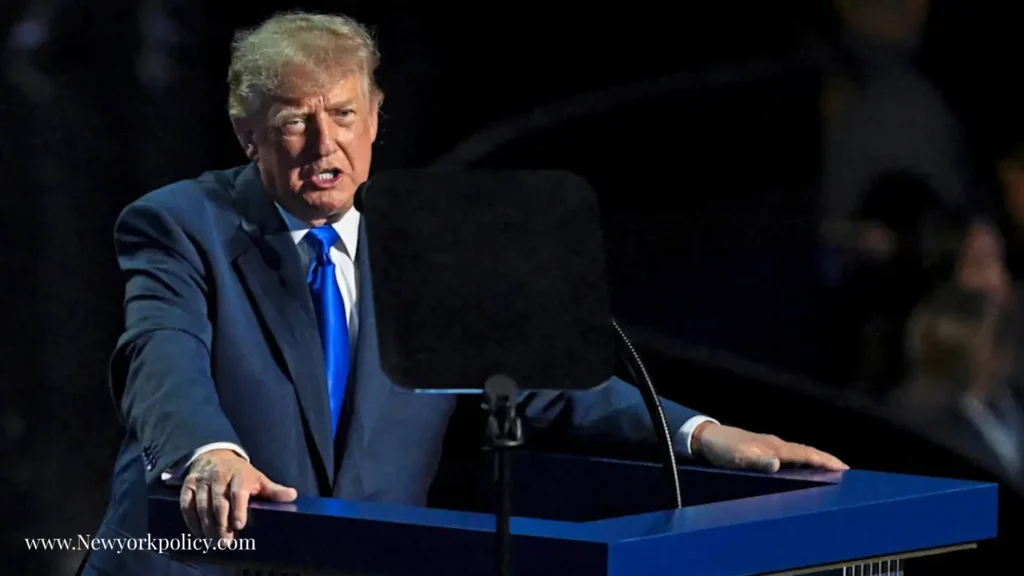
Donald Trump has spent years presenting himself as a central character in some of the defining events of modern American history, and his latest account of the aftermath of the September 11, 2001 attacks has once again drawn attention to that pattern. At a ceremony honoring first responders, Trump described being in Lower Manhattan after the attacks and recalled two firefighters lifting him and carrying him away because a nearby building appeared to be in danger of collapsing.
The story came under scrutiny almost immediately. Fact-checkers found evidence that Trump was in New York in the days following the attacks, and that concerns about unstable buildings in Lower Manhattan were real. But they found no evidence confirming the dramatic detail — firefighters physically carrying him away from the site. That distinction matters. The issue isn’t simply whether one anecdote is accurate. The larger question is what repeated disputes over presidential statements do to public trust over time.
A Story About 9/11 Is Never Just a Story
September 11 occupies a unique place in American memory. Nearly 3,000 people were killed. Thousands of first responders and survivors have lived with long-term health consequences. Families have spent a quarter-century preserving memories of people they lost. That makes personal claims about the event unusually sensitive — when a president places himself inside that history, the question isn’t just whether the story sounds believable. It can also shape how millions of people remember what actually happened.
That’s why documentation matters. In Trump’s case, earlier statements about his role in the recovery effort have also been questioned; PolitiFact reported that a former New York Fire Department battalion chief who worked at Ground Zero said he had no knowledge of Trump being there or bringing a large construction crew to the site. None of this proves every element of Trump’s recollection is fabricated. It does show why extraordinary claims need evidence behind them.
The Bigger Pattern Is Political
This particular controversy looks more significant set alongside Trump’s broader use of social media. In recent weeks, he’s increasingly used highly produced images, videos, and memes to portray himself as a uniquely powerful figure — warrior, commander, dealmaker, historical hero. Recent reporting has described a social-media world in which the president’s public image can drift away from the ordinary constraints of photographic and documentary reality.
That matters because modern political communication is no longer limited to speeches and television interviews. A president can now create an enormous stream of content directly for millions of supporters, with no editor or fact-checker standing between the message and the audience. The result is a political environment where the line between documentation and political imagery gets harder and harder to hold onto.
Facts Can Lose Their Power Without Disappearing
One of the more difficult problems in modern politics is that disproving a claim doesn’t necessarily make it go away. A politician makes an assertion. News organizations investigate it. Fact-checkers publish corrections. Supporters reject the correction anyway. The original claim keeps circulating regardless. Eventually, competing versions of reality just exist side by side, neither one fully displacing the other.
That dynamic can end up mattering more than any single false or disputed statement. Democracy depends on disagreement — Americans can legitimately disagree about taxes, immigration, foreign policy, abortion, trade, or the proper role of government. But disagreement gets much harder to resolve once citizens can’t agree on basic facts in the first place.
The 2026 Election Makes This More Important
The timing here is significant. The United States is approaching another midterm election, and election officials are already preparing for potential misinformation, political interference, and disputes over election administration — Reuters reported this week that officials across the country are bracing for scenarios involving federal pressure, misinformation, and challenges to election procedures.
That means the country’s information environment isn’t an abstract concern. It affects whether voters trust election results, whether citizens accept court decisions, whether people believe government statistics, and whether Americans accept legitimate criticism of their own political leaders. The danger isn’t simply that one politician says something inaccurate — it’s that political loyalty starts determining which facts a person is even willing to accept.
Trump Is Not the First Politician to Build a Personal Myth
Political leaders have always cultivated images of themselves. Presidents have emphasized victories, minimized failures, and shaped their own historical reputations for as long as the office has existed. Trump, though, operates in a media environment that makes personal mythology unusually powerful. A speech can become a video clip within seconds. A claim can turn into a meme. An AI-generated image can portray an event that never actually happened. And supporters can distribute that material faster than traditional institutions can ever investigate it.
Recent coverage of Trump’s social-media activity has highlighted precisely this phenomenon — an online persona that can portray a version of events dramatically more heroic than the documented record supports. The technology doesn’t create the political instinct behind it. It just amplifies it.
The Real Test Is What Happens When Reality Pushes Back
Every president eventually runs into facts that are inconvenient. An economic forecast fails. A military operation gets more complicated than expected. A policy produces an unintended consequence. A court rejects the administration’s position. A political prediction turns out wrong. Leadership requires being able to acknowledge those moments honestly.
A president who can say “I was wrong” doesn’t necessarily become weaker for it — often it’s the opposite. The ability to revise a position when the evidence changes is one of the foundations of responsible government. The problem starts when admitting error becomes politically unthinkable.
The Cost Goes Beyond Trump
It would be easy to file this latest controversy under the endless Trump news cycle and move on. That would miss the bigger issue. The United States needs institutions that can establish facts independently of political loyalty. Journalists need to document what happened. Courts need to weigh evidence. Government agencies need reliable records. Researchers need access to real data. And citizens need to be able to tell the difference between evidence and political storytelling.
Those institutions will sometimes get things wrong, and they deserve criticism when they do. But replacing evidence with loyalty creates a far more serious problem than any single institutional mistake.
The President Does Not Get to Decide What Is Real
The presidency gives enormous power to whoever holds it. It doesn’t give that person the authority to determine historical reality. A president can tell his version of a story, and the public can listen — but records, witnesses, photographs, official documents, and independent investigations still matter, particularly when the story concerns one of the darkest days in American history.
Trump’s disputed account of 9/11 matters, then, for a reason that goes well beyond the details of one anecdote. It illustrates a larger challenge facing American democracy: when political identity becomes stronger than evidence, correcting the record gets harder and harder to do. And when the person shaping that political identity is the president, the consequences stop being merely personal — they become institutional.
The question for the country isn’t whether every presidential story will be perfectly accurate. It’s whether America can still hold onto a shared commitment to finding out what actually happened, even when the truth turns out to be less flattering than the story.
Author