Washington is moving toward a more transactional model of power. The consequences could reshape America’s alliances, trade relationships, and influence for years to come.
For much of the modern era, American power rested on more than military strength — it rested on relationships. The United States built alliances, negotiated trade agreements, backed international institutions, and encouraged other countries to align their interests with Washington’s. The system was never perfect, and American foreign policy has always carried its share of contradictions. But the basic strategy was clear: U.S. power was strongest when other countries had real reasons to keep working with it.
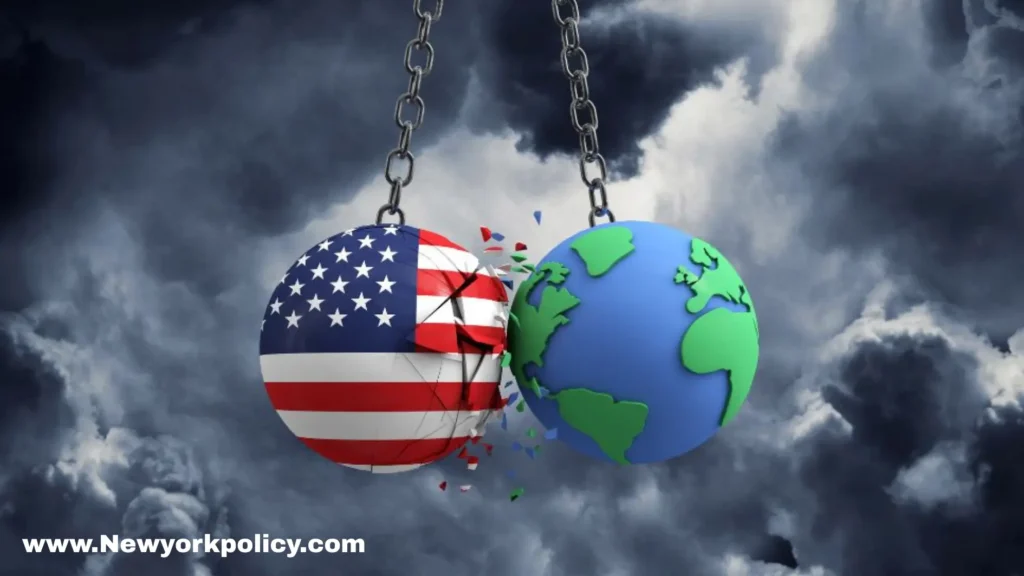
That approach is being tested more directly than at almost any point in decades. Under President Trump, Washington has shifted toward a more transactional style of foreign policy — alliances evaluated by what the U.S. gets in return, trade treated as a running series of bargaining contests, economic pressure used as a central tool, and military and energy policy increasingly bundled into broader geopolitical deals. The clearest evidence isn’t theoretical. It’s playing out right now, in real time, with some of America’s oldest partners.
From Alliance Management to Leverage
America’s traditional alliances assumed that long-term cooperation could serve both sides even when the two sides disagreed. The current approach places more weight on leverage — what each side is willing to give up, and what happens if it refuses.
Canada is the starkest example. Trade talks between Washington and Ottawa collapsed on the night of August 21, 2026, and the U.S. imposed 50 percent tariffs on roughly $20 billion worth of Canadian goods — wine, furniture, dairy, cement, clothing, fishing rods, hockey equipment — at midnight. Prime Minister Mark Carney didn’t back down. He called the U.S. terms “uneconomic” and “unfair,” said Canada had been “attacked,” and announced dollar-for-dollar retaliatory tariffs on American steel, dairy, appliances, agricultural equipment, pulp and paper, and electronics, set to take effect September 8. U.S. Trade Representative Jamieson Greer disputed Canada’s account, saying Ottawa introduced new demands even after Washington offered to lower tariffs on steel, autos, and lumber. Nearly three-quarters of Canadian exports go to the United States, whose economy is roughly ten times the size of Canada’s — which makes Carney’s decision to absorb real economic pain rather than yield genuinely unusual among U.S. allies. As Carney put it when asked whether it felt like open conflict: “Because we were attacked.”
South Korea offers a quieter version of the same dynamic. On August 18, Trump abruptly ordered a “substantial reduction” in that year’s Ulchi Freedom Shield joint military exercises with Seoul — announced on social media just as the drills were beginning, catching South Korean officials off guard. The move sits awkwardly next to the administration’s own 2026 National Defense Strategy, which calls for South Korea to take on more of the burden of deterring North Korea with “critical but more limited” U.S. support — a shift that, if anything, requires more combined training and coordination, not less. South Korean President Lee Jae Myung has responded by both publicly reaffirming the alliance and quietly accelerating an independent path: increased defense spending, a push for greater control over its own nuclear fuel technology, and faster movement toward assuming wartime operational command. That’s not a rupture. It’s a country hedging in real time.
The Cost of Making Allies Nervous
A powerful country can pressure its partners. But pressure has a side effect: partners start planning for a relationship that might not stay dependable, even if the rupture never fully arrives. That rarely produces an immediate diplomatic break. More often, governments quietly diversify — new trading partners, alternative supply chains, expanded domestic defense capacity, closer ties with other major powers.
Canada has already been doing this on a separate front. In January 2026, Carney traveled to Beijing and struck a preliminary deal with China — cutting Canadian EV tariffs in exchange for China lowering tariffs on Canadian canola oil and suspending duties on other agricultural exports — even as Canadian tariffs on Chinese steel stayed in place. That’s a G7 country actively managing a second major-power relationship at the same moment its primary alliance is fraying. The calculation shifting from “we depend on America” to “we need America, but we also need alternatives” isn’t hypothetical in Canada’s case. It’s already been signed.
Trade Is Becoming a Strategic Weapon
Trump has long argued the U.S. has been shortchanged by its trading relationships, and tariffs have become less an economic tool than a form of leverage aimed at political and strategic ends. The Canada confrontation shows both the intent and the risk clearly: Washington defended the new tariffs as a response to unfair treatment of American businesses, but the practical effect has been to push Ottawa toward exactly the diversification Washington doesn’t want. Once companies redesign supply chains, sign new contracts abroad, or open new export markets, reversing those decisions gets much harder — meaning the short-term goal (a better deal) and the long-term consequence (a less integrated North American economy) may end up working against each other.
Europe Is Watching
The implications reach well beyond North America and Asia. European governments have spent years debating how much they can still rely on Washington for security and diplomatic leadership, and Germany’s Stiftung Wissenschaft und Politik — a leading foreign-policy institute — has argued directly that the postwar European security framework built around American protection is becoming less dependable, and that Europe needs to build greater strategic capacity of its own. This isn’t a call to abandon the U.S. relationship. It’s European planners doing the same thing South Korea is doing: preparing for a version of Washington that may show up less reliably than it has for the past 75 years.
Iran Tests the Limits of Economic Power
The same transactional logic shows up in Washington’s approach to Iran, where military pressure — the U.S.-Israeli campaign that began in February 2026 — has been paired with an aggressive economic campaign meant to isolate Tehran. The strategy rests on the assumption that America’s financial reach can make it prohibitively expensive for other countries to keep doing business with Iran. But that leverage depends on other major economies actually going along with it, and China has continued to import large volumes of Iranian crude throughout the war (even as its overall imports fell sharply for other reasons — see below). Washington can impose sanctions. It cannot fully control how Beijing, or anyone else, chooses to respond to them.
Venezuela and the Return of Resource Geopolitics
Energy is the other major front in this shift. Washington’s approach to Venezuela — following the U.S. capture of President Nicolás Maduro in January and the installation of Delcy Rodríguez as acting president — has directly linked political influence to control over future oil development. The August 2026 arrangement gives a U.S.-linked venture, North American Blue Energy Partners, 100-year concessions over 17 Venezuelan oil fields holding roughly 65 billion barrels, with the U.S. government itself holding a 35 percent equity stake through the Department of War’s Office of Strategic Capital. The administration frames it as a historic strategic opportunity; critics — including Harvard economist Ricardo Hausmann — call the underlying political arrangement unconstitutional, given that Rodríguez was installed by court order rather than election.
The significance goes beyond barrels of oil. Control over energy supply, infrastructure, and investment has always shaped alliances and diplomatic relationships, and the Venezuela deal poses the same question other episodes in this pattern do: is Washington rebuilding influence through mutual economic integration, or through direct leverage over another country’s strategic resources? How other governments answer that question for themselves will shape how they read U.S. intentions everywhere else.
Power Alone Has Limits
There’s an important difference between having power and converting it into durable influence. The United States remains extraordinarily powerful — deep financial markets, a highly capable military, real technological advantages, and significant energy resources of its own. But influence also depends on credibility. If allies believe American commitments can shift abruptly — a joint military exercise cancelled by social-media post, a 50 percent tariff imposed at midnight after talks collapse — they become less willing to make long-term decisions that assume those commitments will hold. If trading partners expect tariffs to appear unpredictably, they invest in alternative supply chains regardless of how the current dispute resolves. If governments believe sanctions could eventually reach them too, they build alternative financial channels well in advance.
In other words, the exercise of American leverage can itself teach other countries to build defenses against American leverage. That’s the paradox Washington has to manage, and Canada’s decision to fight rather than fold this August is a live demonstration of exactly that dynamic in motion.
The World Is Already Becoming More Diverse
This shift in U.S. strategy is landing on an international system that was already growing more complicated on its own. China remains a major economic power despite genuine strain of its own; India’s importance keeps growing; Middle Eastern states are pursuing more independent foreign policies; Europe is actively debating strategic autonomy; and middle powers increasingly maintain relationships with multiple major powers rather than picking a single camp. The U.S. can no longer assume other countries will simply follow Washington’s lead by default, because a growing number of them now have real, developed alternatives — Canada’s China deal and South Korea’s accelerated self-reliance push are just two current examples of alternatives becoming actual policy rather than contingency planning.
The Risk of a Less Predictable World
The bigger danger may not be that America suddenly loses its position — it’s that the whole system becomes less predictable. Predictability is valuable for businesses, essential for governments, central to how investors plan factories and supply chains and energy infrastructure, and decisive for whether military planners can actually trust an alliance to hold during a crisis. A world where U.S. policy can swing sharply between one negotiation and the next — a friendly G7 lunch in June, a trade war by August, in Canada’s case — gives every major power a reason to prepare for uncertainty as a baseline condition. That tends to produce more regional arms races, more trade diversification, and more competition over strategic resources, which is precisely the kind of world a strategy built around maximizing short-term American leverage risks accelerating.
What Happens After Trump?
There’s a less-discussed question hiding underneath all of this: what happens if a future administration wants to return to a more traditional, alliance-based foreign policy? Restoring relationships isn’t necessarily as easy as straining them. Companies that relocate supply chains don’t automatically move them back. Governments that invest in independent defense capacity — as South Korea and much of Europe already are — tend to keep investing, since that capacity doesn’t become worthless just because the original justification eases. Countries that build new diplomatic relationships, the way Canada has with China, may find those relationships too valuable to simply abandon once U.S. relations improve. Trust, once weakened, generally takes years to rebuild — which means the effects of this period could easily outlast the administration that produced them.
America Still Has Choices
None of this means the United States is destined to lose global influence. Washington still holds enormous structural advantages; the real question is how those advantages get used. A foreign policy built primarily on pressure and short-term bargaining is one option. Combining real leverage with institutions, alliances, and predictable long-term commitments is another. The two aren’t mutually exclusive — a powerful country genuinely does need the ability to say no. But it also needs partners who believe cooperation with it will still be worth something tomorrow, not just in the current negotiation.
The Next World Order May Be More Competitive
The post-Cold War era handed the United States an unusually dominant global position, but that position was never guaranteed to last indefinitely. The system was already moving toward more competition and diversification before this administration — China’s rise, technological competition, energy geopolitics, and growing dissatisfaction with existing institutions were reshaping the landscape regardless of who occupied the White House. What’s changed is the pace: episodes like the Canada trade collapse, the South Korea exercise cut, and the Venezuela oil deal are compressing years of gradual realignment into a matter of months.
The choice facing Washington, then, is bigger than any single tariff, canceled exercise, or oil concession. It’s a question about what American power fundamentally is: does U.S. strength come primarily from the ability to compel other countries, or from the ability to persuade them that staying close to America remains in their own interest? The answer — visible now in how Ottawa, Seoul, and Brussels are each quietly hedging their bets — could determine whether the next international order stays centered on Washington, or fragments into something considerably more competitive and multipolar. For the United States, that may be the single most consequential foreign-policy question of the decade.
Author