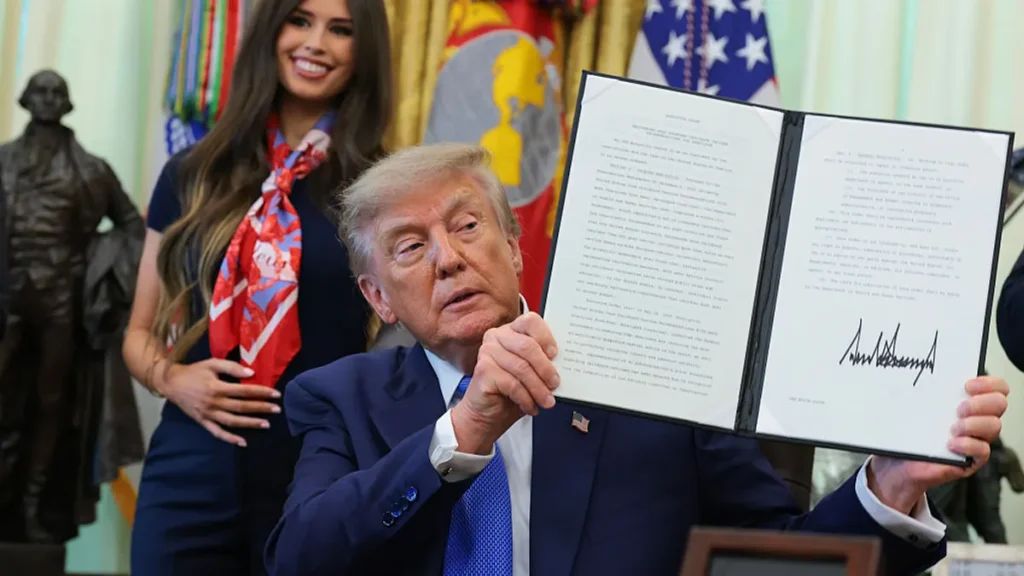
President Trump is celebrating a fresh round of agreements with pharmaceutical companies aimed at lowering prescription drug prices. On August 31, he announced deals with nine more drugmakers — Alcon, Astellas, BeOne Medicines, BridgeBio, CSL, Kyowa Kirin, Sun Pharma, Teva, and UCB — bringing the total to 26 companies since the effort began last September with Pfizer.
The White House says those 26 firms now represent close to 90 percent of the branded pharmaceutical market and, combined, have pledged more than $19.6 billion in new U.S. manufacturing investment. Trump has claimed the deals will save Americans more than $600 billion over the next decade.
Even if that scale of savings materializes, the deals may do little to address the much larger problem confronting American families: the overall cost of healthcare, which is rising on nearly every other front at the same time.
What’s Actually in the Deals
The agreements follow a consistent template built around “most-favored-nation,” or MFN, pricing: drugmakers agree to sell certain medicines to state Medicaid programs at prices no higher than the lowest price charged in other wealthy countries, and to offer some of the same drugs directly to consumers — bypassing insurance and pharmacy benefit managers entirely — through TrumpRx.gov, the direct-to-consumer platform that launched February 5.
In exchange, companies have generally received a multi-year grace period on pharmaceutical tariffs and other regulatory considerations. Pfizer’s original deal, for instance, included discounts of 50 to 85 percent on a broad slate of its primary-care drugs and a $70 billion domestic manufacturing pledge; AstraZeneca followed with discounts up to 80 percent on drugs like its COPD and asthma inhalers.
The administration says the results are already showing up in the numbers: more than $700 million in savings through TrumpRx since February, and — cited by the White House as vindication — a 0.8 percent monthly drop in the Consumer Price Index for prescription drugs in July, the largest such decline since 1963.
Those figures are real. What’s harder to verify is how much of that is actually attributable to the deals themselves, because most of their specific terms — exact discount levels, which drugs are covered, how MFN pricing gets calculated and enforced — have not been made fully public.
That lack of transparency raises the central question: how much will Americans actually save, and for how long?
Drug Prices Are Only Part of the Problem
Prescription drugs get enormous political attention, but they’re only one slice of America’s vast healthcare bill. For most families, the more immediate and much larger problem is the cost of insurance itself — and on that front, 2026 and 2027 look genuinely brutal by recent historical standards.
Enhanced ACA premium tax credits, first expanded during the pandemic, expired at the end of 2025 after Congress declined to renew them. The result: out-of-pocket ACA marketplace premiums jumped an average of 58 percent in 2026, with deductibles rising roughly $1,000 per person on top of that. And 2027 looks like more of the same rather than relief — preliminary rate filings reviewed by KFF show insurers proposing a median 14 percent increase for 2027, which would mean marketplace premiums have climbed more than a third in just two years.
Beyond the subsidy expiration, insurers point to a genuine acceleration in underlying medical costs — the price of hospital care, physician visits, and prescription drugs (including GLP-1s) is projected to rise about 10 percent in 2027, faster than the roughly 8 percent average of recent years.
Employer-sponsored coverage, which still covers most working-age Americans, isn’t insulated either. When healthcare costs climb, businesses absorb part of the increase, but employees typically end up paying more anyway, through higher premiums, larger deductibles, or trimmed benefits.
The same underlying cost pressures — hospital pricing, provider wages, specialty drugs — are pushing employer premiums up right alongside the ACA marketplace.
Can Trump Claim Credit for Falling Drug Prices?
The administration has pointed to July’s CPI drop as evidence its strategy is working. The picture is genuinely more complicated than that headline suggests. Increased competition from generics and biosimilars, along with the separate Medicare drug-price negotiation program created under the 2022 Inflation Reduction Act, are both already pushing some prices down independent of the MFN deals — which makes it hard to cleanly attribute a single month’s CPI move to any one policy.
There’s also a durability question NPR has already started documenting: as of January 2026, all 16 of the drug companies that had signed deals with the administration by that point had still raised list prices on at least some of their other drugs for the year.
That doesn’t necessarily contradict the MFN agreements — companies can cut prices on specific covered drugs while raising list prices elsewhere in their portfolios — but it’s a meaningful caveat to “the biggest win in healthcare history” framing, and it underscores why the undisclosed contract details matter so much. Without them, it’s difficult to know whether these deals represent a structural change in how drugs get priced in the U.S., or a set of negotiated concessions on a relatively narrow slice of each company’s product line.
Other Policies Are Pushing Costs Higher at the Same Time
The drug-pricing push is unfolding alongside broader changes that cut in the opposite direction. The tax and spending package signed into law in July 2025 is projected by the nonpartisan Congressional Budget Office to cut federal healthcare spending by more than $1 trillion over the next decade, and to leave nearly 12 million more Americans uninsured by 2034 — a figure independent analysis suggests could run past 17 million once the expired ACA subsidies and new Medicaid eligibility rules are fully accounted for.
When people lose coverage, they don’t stop getting sick — hospitals and doctors still treat them, and those costs don’t vanish. They typically get shifted onto other patients and insurers through higher prices elsewhere in the system, which is part of what’s already showing up in 2027’s proposed premium increases.
That creates a genuine contradiction sitting at the center of current health policy: the same administration touting historic drug-price savings is simultaneously overseeing policy changes that are projected to raise the number of uninsured Americans and push insurance premiums up by double digits for a second straight year.
There Is No Single Solution
America’s healthcare affordability problem can’t be solved by one set of agreements with pharmaceutical companies, however large the number of participating drugmakers gets. Prescription drugs matter, but so do hospital costs, insurance premiums, administrative overhead, physician compensation, and the rising cost of advanced treatments like GLP-1 drugs and specialty biologics — categories insurers are explicitly citing as 2027’s biggest cost drivers.
The real policy challenge isn’t making one part of the system cheaper. It’s preventing savings in one corner — even a genuine $600 billion, decade-long drug-price reduction — from being swamped by cost growth everywhere else.
Trump’s MFN agreements may deliver real, lasting relief on the specific medicines they cover, particularly for the roughly 500,000 seniors who’ve already saved a combined $216 million on GLP-1 drugs through the $50-a-month senior program launched in July. But most Americans are unlikely to feel meaningfully better off if their insurance premiums keep climbing by double digits, their deductibles keep rising by a thousand dollars a year, and millions of their neighbors lose coverage entirely over the same stretch.
The political victory is easy to announce on a Monday in the Oval Office. Actually solving America’s healthcare cost crisis will take a great deal more than that.
Author